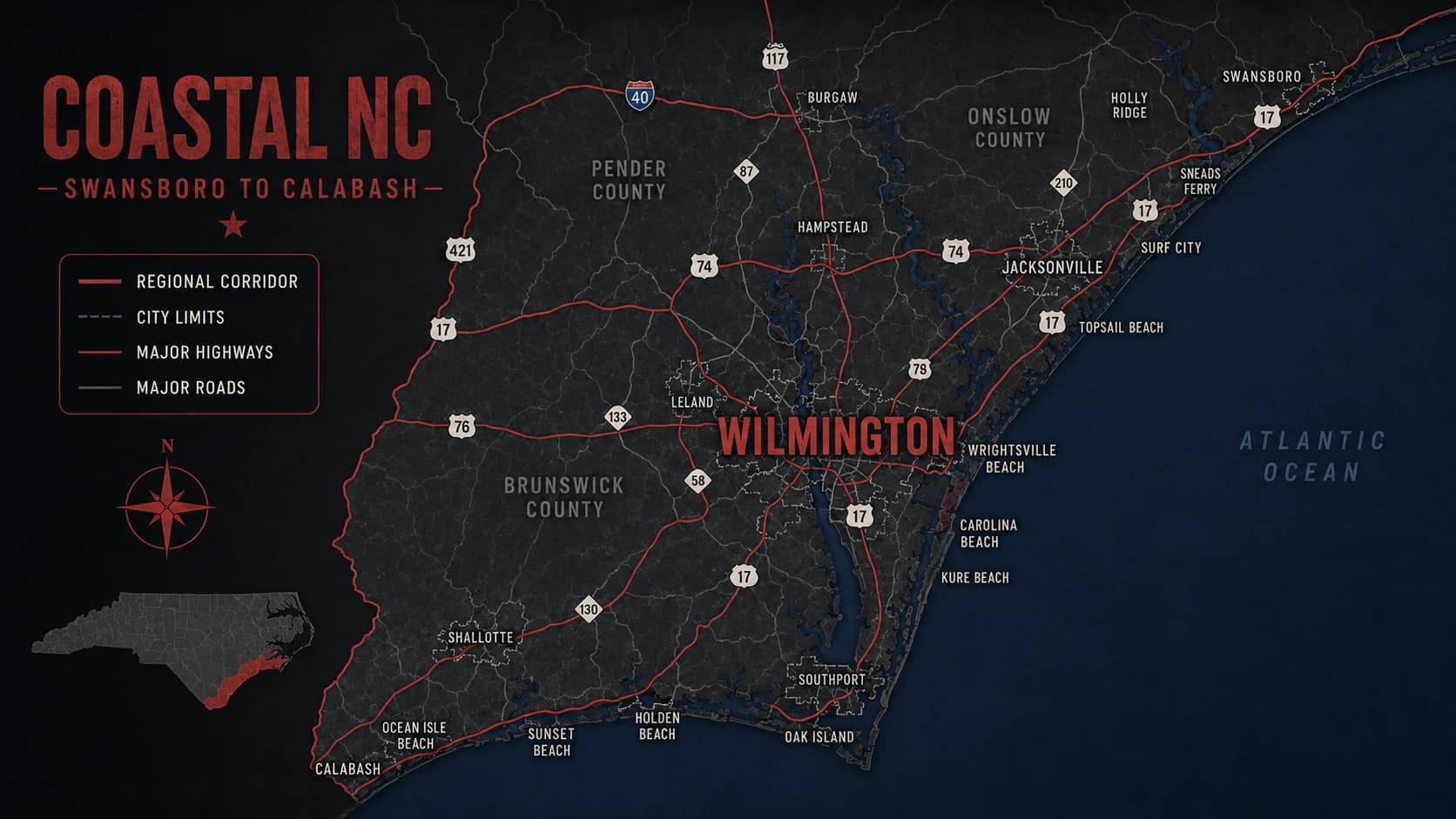
Roofing materials for coastal North Carolina — what holds up and what doesn't.
Choosing a roofing material on the NC coast isn't the same decision as choosing one inland. Salt air, wind load, heat, and humidity eliminate some options and make others clearly superior. Here's the honest breakdown.
Free material consultation with every inspection. Serving Wilmington and coastal NC.
The Environment
The coastal NC roof environment — what makes it distinct.
Wilmington and the surrounding coastal communities face a combination of stressors that most inland homes don't: sustained salt air within a mile or two of the coast, humidity that rarely drops below 60%, summer heat that regularly exceeds 95°F, and the periodic threat of named storm winds exceeding 100 mph. A material that earns an “excellent” rating in the manufacturer's marketing was likely tested in conditions that don't include all of these simultaneously.
Salt corrosion
Accelerates oxidation of metal components (fasteners, flashing, drip edge, gutters). Homes within 1 mile of water face materially more corrosion than those 5+ miles inland.
Wind load
Building codes classify coastal NC as a wind-borne debris region, requiring higher fastener counts and specific installation patterns. Not all shingles are rated for these requirements.
Heat and UV
Coastal sun degrades asphalt adhesives and granule adhesion faster than northern climates. Dark-colored roofs absorb significantly more heat.
Moisture cycling
High humidity plus summer heat means roofing materials expand and contract more frequently than in drier climates, working at seals and adhesives over time.
The Materials
Every major roofing material — coast-adjusted.
Architectural Asphalt Shingles
Good — Most Common Choice
The industry standard for residential roofing across the US. On the NC coast, architectural (laminated) shingles perform better than 3-tab due to heavier construction and better wind resistance. For most homeowners, this is the practical choice — it balances cost, durability, and availability of qualified installers.
Pros
Cost-effective; wide color/style selection
25–30 year manufacturer warranty
Works with FORTIFIED installation standards
Easy to match for repairs
Cons
Shortest lifespan of the options listed here in coastal conditions (18–22 years)
Granule loss from UV and hail
Adhesive degradation from heat cycling
Susceptible to wind lift if not properly fastened
Cost: Mid-range. Most cost-effective option at time of installation.
Impact-Resistant (Class 4) Asphalt Shingles
Very Good — Recommended for Hail Zones
Class 4 impact-resistant shingles are the same asphalt base as architectural shingles but with a modified rubber or polymer reinforcement that withstands hail impact without cracking. Many NC insurers offer a 20–30% premium discount for Class 4 roofs.
Pros
Insurance discount eligible
Better resistance to hail damage
Longer effective lifespan than standard architectural
Qualifies for FORTIFIED installation
Cons
Higher upfront cost (15–25% over standard architectural)
Limited style selection compared to standard architectural
Cost: Mid to upper-mid range. Often cost-neutral over time due to insurance savings.
Standing Seam Metal
Excellent — Best Long-Term Option
Standing seam metal (typically steel or aluminum with painted finish) is the top-performing roofing material for coastal NC. Concealed fasteners eliminate the primary failure point of exposed-fastener metal. Modern paint systems resist salt corrosion effectively. Properly installed standing seam metal routinely lasts 40–55 years on the NC coast.
Pros
Best coastal lifespan (40–55 years)
Superior wind resistance; low maintenance; fire resistant
Energy efficient (reflective finish); no granule loss
Qualifies for highest-tier FORTIFIED and insurance discounts
Cons
Significantly higher upfront cost (2–3× asphalt)
Requires specialized installation expertise
Expansion/contraction noise on hot days
Limited installer pool means quality varies
Cost: Premium. Higher initial investment with significantly lower lifecycle cost.
Exposed Fastener Metal Panels (Corrugated / R-Panel)
Fair — Appropriate for Outbuildings and Utility Applications
Exposed fastener metal is common on outbuildings, covered porches, and utility structures. For primary residential roofing, the exposed fasteners are the limiting factor — they require periodic inspection and replacement as washers degrade, and corrosion at fastener penetrations is a recurring maintenance item in coastal environments.
Pros
Lower cost than standing seam
Durable for outbuildings; quick installation
Cons
Fastener corrosion in salt air
Periodic maintenance required
Not recommended for primary residential roofing near the coast
Not eligible for standing seam tier insurance discounts
Cost: Lower cost. Appropriate for secondary/utility structures.
Concrete Tile
Good — Excellent Wind Resistance, Higher Weight
Concrete tile has excellent wind resistance and longevity when properly installed. The primary concerns on the NC coast are weight (older homes may need structural assessment) and the susceptibility of the concrete surface to algae and moisture intrusion in high-humidity environments. Clay tile shares similar properties with better moisture resistance but higher cost.
Pros
Excellent wind resistance
Long lifespan (25–40 years coastal)
Non-combustible; good thermal mass
Cons
Heavy — requires structural verification
Algae growth in humid climate
Individual tiles can crack from impact; replacement tiles may not match aged field
Higher installation cost
Cost: Premium range. Higher installation cost due to weight and specialized installation.
Cedar Shake
Not Recommended for Coastal NC
Cedar shake performs well in dry climates. On the NC coast, the combination of salt air, high humidity, and warm temperatures creates ideal conditions for mold, rot, and moisture intrusion. Despite treatment, coastal cedar shake typically requires replacement in 12–18 years — often less than the cost-equivalent architectural asphalt option.
Pros
Aesthetic appeal; natural material
Cons
Shortest lifespan in coastal conditions
High maintenance; susceptible to mold and rot in humid climate
Fire risk without treatment
Limited insurer acceptance
Cost: Premium cost for shorter coastal lifespan — not recommended.
Our Recommendation
What we actually install on coastal NC homes — and why.
For most homeowners, the decision is between high-quality architectural shingles (or Class 4 impact-resistant) and standing seam metal. The right choice depends on your budget, how long you plan to stay in the home, your proximity to the water, and whether insurance savings factor into your analysis. We install both. We'll tell you which one makes more sense for your specific situation — including the numbers.
Staying 5–10 years
Best architectural or Class 4 impact-resistant shingles. Cost-effective replacement that protects the home and likely qualifies for insurance improvements.
Staying 15–20+ years or waterfront
Standing seam metal. The math favors metal when you're planning for the full lifecycle.
Insurance optimization
Class 4 shingles or FORTIFIED-eligible installation of any material. Premium reductions of 20–30% are possible with the right product and installation method.
Common Questions
What homeowners ask us about coastal roofing materials.
Free Consultation
Not sure which material is right for your home? Let's talk.
We install the full range and have no material incentive to push one over another. We'll give you the coastal-specific breakdown for your home's age, location, and ownership timeline.